49. Cabecera noticia XVI Congreso APIA
SIGAUS and GENCI advocate traceability as an antidote to environmental misinformation at the 16th APIA Congress
The 16th Congress of the Association of Environmental Journalists (APIA), held recently at the Círculo de Bellas Artes, focused its debate on the proliferation of fake news and the need to reinforce the accuracy of information. In this context, SIGAUS and GENCI championed traceability, technology and transparency as essential pillars for ensuring rigorous communication in the management of used industrial oil and packaging waste.
 02-12-2025
24. Parrafo noticia XVI Congreso APIA
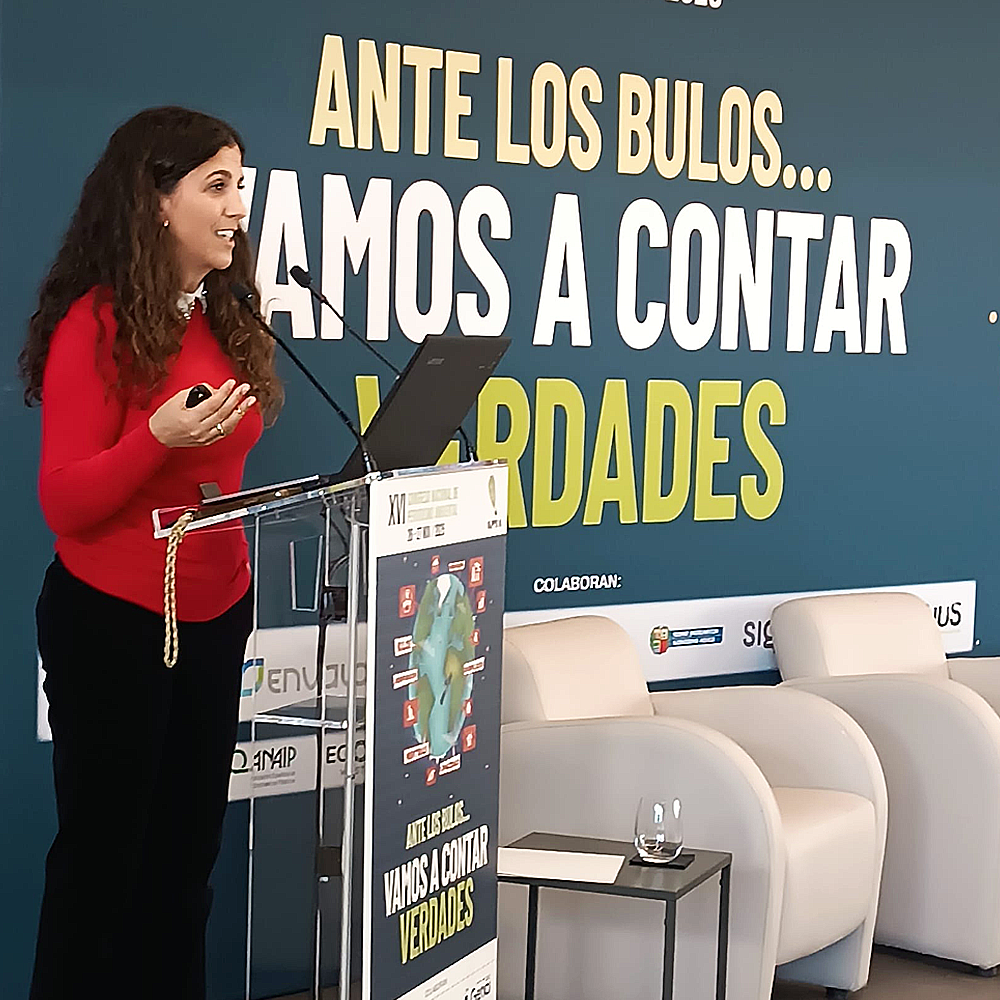
The 16th APIA Congress brought together journalists and environmental communication specialists for two days under the slogan “In the face of fake news... Let’s tell the truth”, with the aim of analysing the rise of misinformation and its impact on public perception of climate and environmental challenges. The event included panel discussions, analysis of real cases and reflections on the role of media in the fight against manipulated or inaccurate content.
Among the case studies presented, Ainhöa Lizarbe, Director of Communications and Institutional Relations at SIGAUS and GENCI, gave a noteworthy presentation in which she explained how both entities base their information model on three fundamental pillars: traceability, technology and transparency. According to her, these pillars make it possible to construct “verifiable truth” in the management of used industrial oil and commercial and industrial packaging.
Lizarbe presented the Waste Oil Observatory, a tool for viewing the traceability of this waste across Spain using geolocation methods. The information is taken from the official documents regulating the delivery and transfer of waste oil, which guarantees its reliability. The observatory shows both the generation points and the management facilities, offering an accurate picture of how this waste is moved and treated in Spain.
32. Parrafo cita noticia XVI Congreso APIA
“
Our Observatory allows us to track 195,000 collection operations per year. Every time a drop of used oil is moved in our country, we track it, and that’s exactly what we’re going to achieve with the packaging.
„
The communications director at SIGAUS and GENCI also highlighted that this geospatial technology has been transferred to GENCI’s Observatory of Commercial and Industrial Packaging Waste, thereby expanding the analysis capacity to a new waste stream. “Our Observatory allows us to visualise the traceability of 195,000 collection operations per year. Every time a drop of used oil is moved in our country, we track it, and that’s exactly what we’re going to achieve with the packaging. It’s not just about managing this waste properly, but about being able to verify that management,” she said. “Technology allows us to transform data into useful information that we can share. As SEPRS, we have an obligation to raise awareness, share information and inform public administration bodies. And once we’ve traced the information, the technology of our Used Oil Observatory allows us to divulge it,” added Lizarbe.
The conference also devoted time to reflecting on misinformation related to environmental phenomena and natural disasters, with panels such as “Misinformation in the face of natural disasters and climate change” and “Journalism in the face of misinformation”. These sessions emphasised the importance of specialised journalism and the rigour required in covering environmental issues.
The closing ceremony was chaired by Sara Aagesen, Deputy Prime Minister and Minister for Ecological Transition and Demographic Challenge, and included a tribute to Gustavo Catalán, a specialised eco-journalist, and Mario de la Mano, who passed away last May, both prominent figures in environmental journalism in Spain.